
Cochran Projected and Actual Release
A projection is a calculation, not the completed event. TDCJ defines Projected Release Date as the date Classification and Records determines a prisoner is expected to leave confinement if parole does not occur sooner. Offense title, offense date, and the governing statute matter. The field is not parole eligibility, approval, scheduled pickup, or actual release.
Cochran County's Interop jail report has no projection field. It shows days in jail and a broad status, but those values omit sentence credits, pending orders, and other holds. A pretrial person may leave by bond or court order and may have no sentence-based date at all.
Find a Cochran Projected Release
The TDCJ offender search covers state prison and state-jail custody, not an ordinary Cochran bond-out. It accepts name, TDCJ number, SID number, gender, and race. An identifier is safer than a name.
- Determine whether custody is county, state, or another system.
- For TDCJ, match the identity and open the detail.
- Read Projected Release Date with offense and Parole Review Information.
- For a county sentence, obtain the judgment and jail-time credit, then request the jail calculation.
- After the expected date, verify actual status with the custodian.
TDCJ warns that data is updated on working days and is at least 24 hours old. Its email information service can provide history and a Projected Release Date with enough identifying detail. The Cochran release-record path explains the separate Sheriff and court records.
The TDCJ information fields appear here.
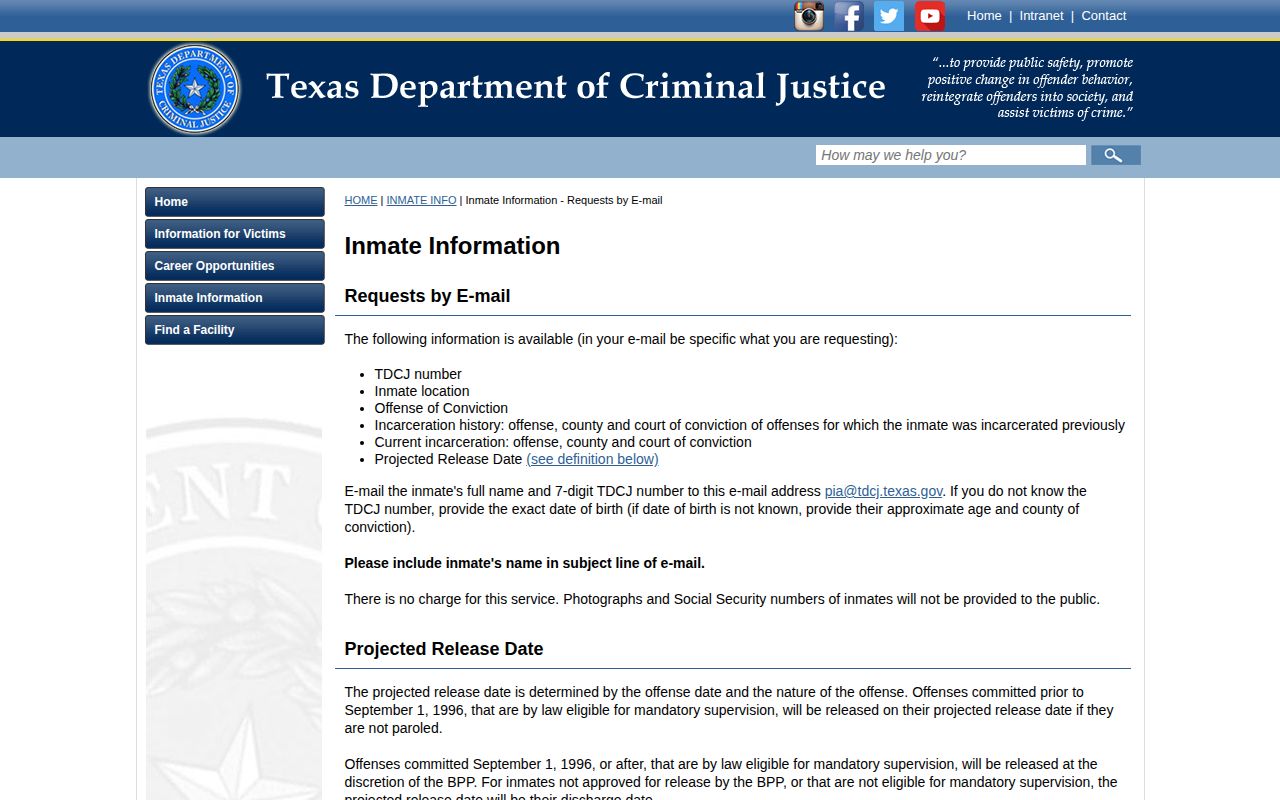
This is a state information channel, not a county-jail calculation service.
Texas Good Time for Cochran Cases
Government Code Chapter 498 says good-conduct time affects parole or mandatory-supervision eligibility and does not otherwise shorten the sentence. It is a privilege, not a right. Classifications award different credits, qualifying program work may add credit, and discipline may cause forfeiture or suspension.
Texas has no blanket 85-percent rule. Covered serious or deadly-weapon cases often use actual time equal to half the sentence or 30 years, whichever is less, subject to the statutory minimum. Other cases may use flat time plus good time reaching one quarter of the sentence or 15 years. These are eligibility rules, not promised releases. Offense date, judgment findings, and statutory exclusions control.
Mandatory supervision is separate. Credit equality, eligibility, exclusions, and any required Board review all matter. Reaching a threshold does not create a right to immediate parole.
Why Cochran Release Dates Change
The practical date can move as legal, custodial, and administrative facts change. TDCJ may recalculate credits or sentences. The Board may deny parole, approve it with conditions, or require a program. Another agency may lodge a detainer, a request to hold or transfer the person.
| Factor | Possible effect |
|---|---|
| Good-time discipline | Credits may be lost or suspended. |
| Parole action | Approval may permit earlier release; denial may leave a later date. |
| Required program | Completion may delay scheduling. |
| Detainer or hold | Release may become transfer. |
| Court order | Credit or sentence changes alter the basis. |
| Consecutive sentence | Another sentence enters the calculation. |
After favorable parole action, TDCJ audits the certificate and may display Scheduled Release date and location. A cited example uses a business-day audit period, but it is not a universal timetable. Dates can change on release day.
Confirm a Cochran Release Date
For a county case, obtain the court order and ask Sheriff records for the calculation or actual event. Do not calculate from displayed jail days. Bond, another warrant, transfer, or new court action may control. For TDCJ, compare the detail, Parole Review Information, and IVSS event, then confirm after release.
The Cochran VINELink inmate search can register a county custody alert when the agency participates. Use IVSS for TDCJ. An alert is not the originating log, so follow it with agency verification.
TDCJ's projected-date definition appears here.
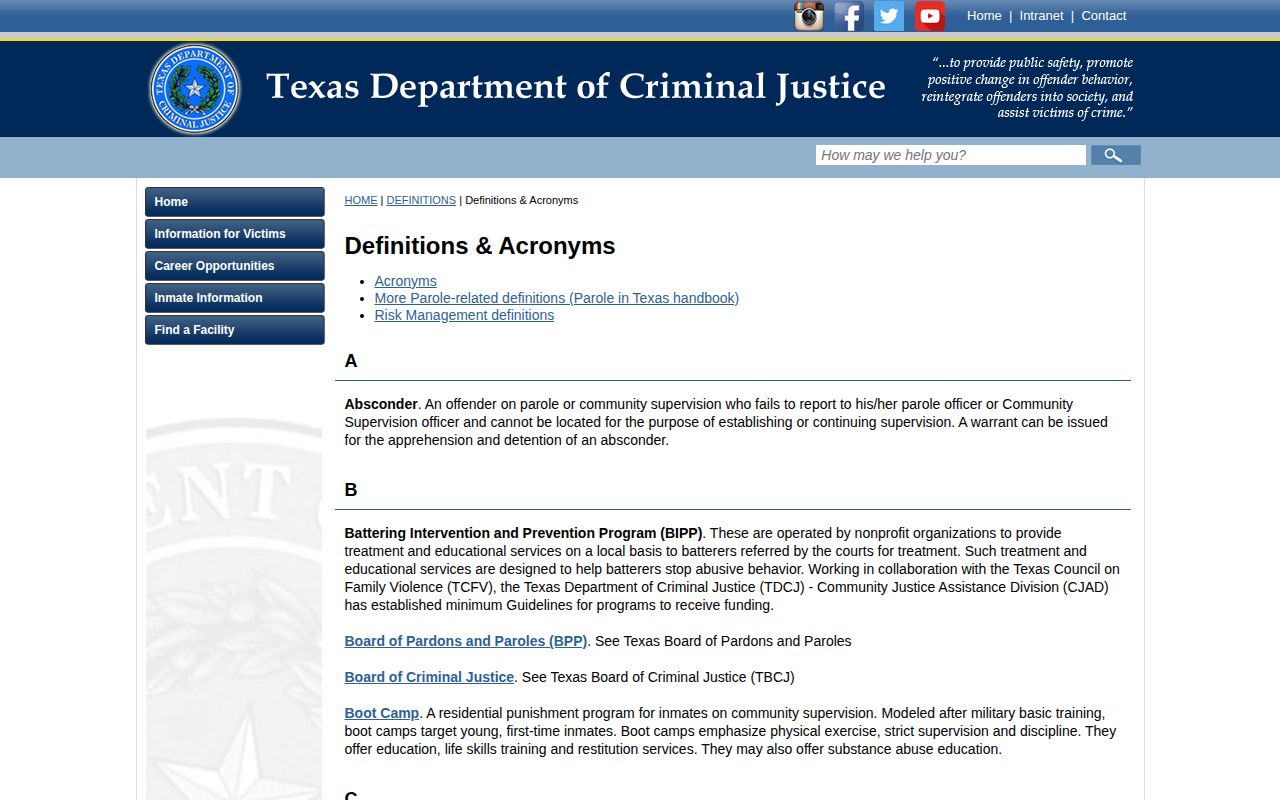
The definition shows why the date remains predictive.
Cochran Release Date Reconciliation
Cochran's local status RELEASED gives no reason or destination. The Sheriff's worksheet also records aggregate paper-ready inmate-days awaiting state transfer. That figure is not a count of people or releases, but it shows why county custody may lead to TDCJ instead of community release.
Parole in absentia adds another quirk. A person paroled from county jail may lack a TDCJ-posted calculated release date. Reconcile the court disposition, Sheriff log, and TDCJ or Parole Division record rather than forcing one screen to answer all three questions.
If the court shows prison commitment and county status changes, allow for TDCJ's lag. Search by SID or TDCJ number. If unclear, use TDCJ history and ask whether the Sheriff event was a transfer.
Cochran Pretrial Release Timing
A bond amount does not create a release date. It records a condition on a charge. Departure may still depend on payment or approval, identity checks, other warrants, a signed order, and jail processing. A personal bond explains authority but not the moment the person left.
For a pretrial detainee, check the court order and Sheriff event. For a county sentence, request the judgment, credit, and existing calculation. For a state sentence, use TDCJ's field. Keeping those paths separate prevents a guessed date from being presented as official.
Cochran State Release History
When the online TDCJ result is absent or unclear, email the agency information service with the full name and seven-digit TDCJ number. If that number is unknown, use the exact date of birth or approximate age and county of conviction. TDCJ says the response can include the TDCJ number, location, current conviction details, past incarceration history, and Projected Release Date at no charge. It does not provide photographs through this channel.
That history is useful after full discharge or when a working-day update lags the event. It still must be matched carefully to the intended Cochran County case. A prior incarceration date does not prove the timing of a new county booking, and a projected date does not replace the final release entry.
Cochran Mandatory Supervision Rules
Mandatory supervision should not be merged with parole eligibility. For eligible cases before September 1, 1996, TDCJ describes the Projected Release Date as the scheduled mandatory-supervision date when flat time plus good time equals the sentence, unless parole occurs first. For eligible offenses on or after that date, discretionary approval is also required. A denial may move the projection to maximum expiration, while later approval can move it earlier.
Government Code Sections 508.147 and 508.149 govern release and exclusions. Offense date and the exact judgment matter because amendments and disqualifying offenses change the result. A person who is ineligible for mandatory supervision may have a Projected Release Date based on maximum expiration. The field cannot be decoded with sentence length alone.
No public calculator can safely resolve those facts for a Cochran case. Obtain the judgment, sentence, offense date, and TDCJ calculation, then apply the agency definition.
After Cochran Parole Approval
A favorable BPP vote begins another stage. The complete vote may require treatment, a residence plan, a specified month, or other prerelease work. TDCJ audits the certificate and may later display a Scheduled Release date and location. Those fields are more developed than a projection, but TDCJ warns that they may change without notice, including on the expected day.
- Read Parole Review Information on the correct TDCJ detail.
- Interpret the complete vote through BPP's current vote options.
- Wait for any required program and record audit.
- Check for Scheduled Release fields and register in IVSS.
- Confirm with the unit or release-status line before travel.
Approval is not physical release. The person remains incarcerated until processing ends. After departure, verify whether the result is parole, mandatory supervision, transfer, or full discharge.
Cochran County Time Credits
A county sentence calculation belongs to the judgment and jail records, not the public TDCJ field. Ask the clerk for the sentence and jail-time credit. Then ask the Sheriff for the existing calculation and final event. The roster's days-in-jail display and total bond are not substitutes.
County time may intersect with a state commitment. Texas law contains certification rules for qualifying county-jail time while awaiting transfer and some work-program credit, but the record must show what was certified. Cochran's paper-ready statistic proves local transfer delay in aggregate, not any individual's credit.
If calculations conflict, compare the offense, cause number, sentence sequence, credit date, and custodian. Consecutive sentences, another hold, or a corrected judgment can change the result. Request the agency calculation instead of creating a personal prediction.